Preloader

“The Whispering Grandfather” by Bradley Walker

   This is a long story, I know. But by rights it should be as it spans the decades of my own life, up until last month. I understand we all find ourselves busy with the ever-present worries, priorities, and goals within our own transience, but I beg those with a little time to read on, and share this tale of creeping discomfort with my old soul.

   We all have issues in our families; skeletons in the closet enough to fill old, forgotten catacombs. Most of these are mundane and ubiquitous. Secret shames that ‘tarnish’ the family name, regardless of the fact that the very skeleton itself is placed in every family’s closet. Affairs, ‘illegitimate’ children, conservatorships, drug addled child, alcoholic aunt, handsy uncle, the list goes on. However, my family were different. We were always a small family, and never really involved ourselves in the lives of any extended blood. My mother’s side was larger, but lived further afield. My father’s on the other hand- me, him, his parents. There was no shame, no silly accident or act of infidelity. Our skeletons weren’t trivialities tucked behind a chrisom or shroud of shame, but something much more sinister. Something that I believe, to this day, is wholly inexplicable. I would go as far as saying: We didn’t have endless little skeletons in our closet, but one titanic demon.

   I think it’s nigh time I tell this story. The burning stitch has been woven in and out of my life over the years, though, I was lucky enough to never wear the garment it birthed directly. But, as I’ve gotten older, I’ve found myself in a predicament that none should ever face… objectively. And thus, let met tell.

   My mum and dad were always quite reticent when it came to talking about my grandfather on my dad’s side. It’s not as if they’d outright refuse to speak about him, but whenever he was brought up – say, a neighbour innocently asking how the folks are doing – the mood would just change so suddenly that it would almost give me whiplash. I still remember, very clearly, my mum would grow harrished and flustered, then try to commandeer the conversation, talk about her own parents (both deceased before I was born) and then steer the topic in to other territory. “How are yours?” “Did you hear…?” “How’re your babies? They must be xx old now!”

   I was a child, so never delved deeper than the surface level of the circumstance. I had much more important things to think about; games for school, tardy homework, the next toy, the lost toy, the favourite toy. I was an inquisitive child, relatively, but only in things that struck a chord of interest to me. Unfortunately, my mother’s deterrence whenever her father-in-law was brought up, my father’s sudden iron-clenched expression of discomfort, was never really factored in to it.

   The first time I noticed there was something actively queer, as in, it showed up as a curious blip on my juvenile radar, was when I was nearing the end of my primary school years. We were tasked with mapping our family tree as far as we could go back. We were given large A1 pieces of card in which we were supposed to snip out old photographs, or have them copied and cropped, then stuck to the card. These would be linked to show our heritage, and go as far back as was possible.

   I was absolutely ecstatic about this. Not only was it a break from the dull monotony of sums, science and spelling, but it was practical, personal. School back then was hardly either. I was charmed by the idea of finding out about ancestors I’d never get the chance to meet, yet was effectively a product of. I ran home to my mother, as my dad was out on an errand, and told her what I needed. The reaction was instant, physical and visible; jaw clenched, eyes widened, and a blotchy pervasion of red stole over her face. She grew flustered and irate, though I knew it wasn’t with me. She began stuttering and spluttering, before regaining composure after a few seconds, then in a way that is so natural to adults, dismissed me with a “Let me speak to your dad later,” followed by a stern, direct order of, “Don’t mention this again.”

   Later, my dad came home, strolled passed me with a ruffle of the hair and a promise to talk about school after a cup of tea. He headed to the kitchen where my mother was perched with a crossword – though, I’d popped in three times for snacks and noticed she hadn’t spared time for even a guess. I heard her voice, low and mumbled, as she spoke to him. His response was a shout that was quickly stifled in to sharp whisper, and, seconds later, there was a heavy thud. I sprung from the couch to sneak a peek, and saw my dad nursing his fist, which he had evidently slammed in to the marble counter top. He was furious, steely and rigid. My mother, rather than annoyed at his outburst, seemed sympathetic toward him. She spotted me as she began to soak a kitchen towel, and with a quick jolt of the head, sent me to my room. I obeyed without question, but full of guilt for knowing this was somehow my fault.

   The next day in school, I was approached by a fretful and vehemently apologetic Mrs. Frost, who proceeded to paint me with all colours of regret, and then exempted me from the assignment. I was told to sit out and read for a while as the other students worked on theirs. I never complained. I liked reading. At the end of that week, all my peers had bright, colourful family trees; a whole forest of ancestry. But mine? Not even a seed to tell of my heritage.

   There was a smattering of moments like that when I was younger. Snippets of extreme tension, my mother and father squirming in anger, discomfort, sometimes even fear. People behaving differently around me. It wasn’t a constant threat, and mostly, my parents were a typical, happily married couple. But after that assignment, the thought of my grandfather compelled a morbid, forbidden curiosity in me. It was always muted and repressed, but ever-present.

   I’m no longer a kid; far from it as my well-earned beer gut and wispy hair clutching around each side of my head, but for the tuft at the top, will attest to. And still, for a long time I found myself telling my kids that they’re not to ask their granddad about his dad. This initially conjured some questions, as they plied the same curiosity I’d learned to silence, mostly, but sooner or later they stopped asking. This was prudent, because my dad wouldn’t answer me, so I couldn’t answer them. All I told them when pressed was that we don’t know much about him, and that families were different.

   Families were different. I always knew that. My friend had a whole hospital bed in their living room for their nan, who was apparently ‘not long for this world’ but stayed alive well in to my teens. We used to sneak over and look at all the buttons, read the little canisters and examine the devices as she lay still and withered, her laboured breathing a languid, raw rhythm – a strenuous metronome that lulled between the sporadic beeping and sudden gulping bubble of her drip. It was interesting rather than saddening. I knew grandparents were old, could get sick, could pass away – so I had no idea why everything was being shielded from me. My friend knew exactly what was happening with his grandmother, why couldn’t I be offered the same?

   The insight I did manage to glean was harrowing. So, even the little loose, ill-fitting puzzle pieces I’d managed to mentally grasp made no sense when placed together. You see, from the ages of, perhaps, five to ten, or at least somewhere there around, I did get to go to my grandparents’ house. And, though I could tell there was always something out of the ordinary, it didn’t seem at all unnerving or aberrational at first. I was told my grandfather had to stay in the other room, and that seemed acceptable enough for my young brain. He must be sick. He’s not long for this world. That’s all, right? I realised my aim was well off-target for truth.

   Overall, I visited my only grandparents only a handful of times, and it was always due to my grandmother being poorly. I used to get so excited, though, because every visit, I would be driven to the toy shop on the way, and my dad would always pick out something new for me. Toys back then weren’t as varied as you can get today, but my dad used to always say the ones with lights and sounds were the best ones, regardless of whether I wanted them or not. Then, we would pop by a pet store! They loved animals, my dad explained. They help them grow up, then give them to other families. That, as you can imagine, was the highlight of my year. Mostly, we’d get them a hamster or gerbil, something small, furry and cuter than I could handle. Once we got a kitten. Oh, to be a child of no worries, with a brand-new toy and a scuttling little mammal to hold.

   After that, we would be driving to their home which was a little further out than I would have expected. When the suburbs gave away to bosky landscapes, the mood within the car would change, and my mum and dad wouldn’t say a word to each other. My dad would usually drive, and his motions with the handbrakes would be sharp and staccato, he’d be grumbling and grunting swear words at any other driver on the road, and when they seemed to dwindle in numbers, his wrath would shoot at any road sign, or sight, or- whatever he could find to hate.

   God forbid we were ever stopped at a red light. How ghastly that would be… The entire duration would be spent with him leaning forward, his elbows on the steering wheel, and supporting his head in his hands as if this was a travesty. He’d keep glancing in the back seat, and as if I was a spectre, ignore me and fix his eyes on their new pet. As if making sure it was still there. My mother would wait a moment, then when the lights started changing, place a gentle, reassuring hand on his shoulder which didn’t do much to alleviate his mood, but he’d at least look up to the side, lock eyes with her, take her cue and then press on the pedal.

   When I got there with my rocket, or robot or roaring dinosaur (cliché, I know) in hand, my grandmother would be sitting in her little pyjamas of the year (she got a new set sent in the post every Christmas from us), and would pull me in to her arms the second I tottered through the door. Within seconds I’d be met with a thousand kisses from her wrinkled, dry lips, and with the aid of breath that smelled like sugary tea, I was asked all manner of questions about my school life, my friends, and get showered with all manner of sweets she’d been saving for me.

   The house was, by any stretch of the imagination, an ordinary grandparent’s house. My grandmother’s chair was positioned just in front of an antique grandfather clock, and on either side of that were about a thousand pictures of me that I can’t remember being taken, or of my mum, dad and me together. She would have birthday cards and Christmas cards in their envelopes, “The ones we missed, and the one we’ll miss,” she’d say with no sadness, or joke, nor anything but accepted fact.

   In truth, I loved the attention. It was as if all this silence and hush that forced this strange stigmatised super-injunction on my grandfather was remedied in the arms of such a sweet old woman. She had the lovely delicate voice that the kindly, gingerbread making grandmothers in movies had. She would nestle me in to her breast, have one hand stroking my cheeks in relaxing circular motions, and the other playing with my hair – twiddling it this way and that as she told me how lucky I was to have such golden curls (I remember them fondly), and that she thought about me every day, that she was so proud of me and she loved me more than… and then go on to reel off as many items she could list, before deciding any word she ever learned could never do it justice.

   And, I craved it. Just the knowledge that my grandmother was the perfect archetype was enough to offer equilibrium to whatever was going on with my grandfather.

   The only thing, though, was each time, the visit would turn immensely sour after maybe thirty minutes to an hour or so, which is when the sudden normality of the visit would begin to fizzle treacherously. Even at my earliest memory, I remember a shiver of discomfort tickle through my body, because from the other room, there would be a chorus of whispers – just loud enough to be heard – emanating through. As soon as they started, my grandmother would pause for a moment, and I’d watch as she shot a glance to my dad, who would then turn to my mum. I’d usually capture her “don’t-let-Edward-know-we-are-arguing” face, as my dad’s brows furrowed, and his eyes began to fill with rage.

   Then, from the other room, the whispers would incrementally increase in volume, so that I could hear individual words being spoke, but too muffled to make them out. The rhythm and general sound of them didn’t seem exactly natural to me, there were a lot of consonants and more “s”s than I knew a language to have, but that was probably due to the fact that they were still, in nature, faint whispers. Whisper a ‘hello’ to yourself now, and let the breath push gently at your throat, and barely escape past the teeth – that was the quality the entire sentences would form in. Only when there would be a sudden shout, or visceral bark which caused my grandmother to flinch and quickly regain composure, would my dad stand up, in a fit of rage, storm over to the pet, pluck it up and then disappear. Suddenly my nan would forget about asking me any and all questions, and then my toy would be the star of the show.

   The radio would get turned up then, and the television, so the two could wage sonic war on one another. Amidst this sudden chaos, my nan would have me howling with laughter as she tried to copy the noise of the toy, in an absurdly loud and dramatic imitation, that I would have to copy; the two of us bouncing off each other’s mimicry until we were both screeching at the top of our voices.

   …and I knew it was a distraction technique even then, because my mum would only be watching with half her heart. Her eyes were on us, her smile was fixed – almost programmed or rehearsed – in place, but her mind and hearing wERE tuned to the door. The barks, grunt and sudden outbursts from my grandfather were still there, but added to them, the challenger of my dad’s anger, built up and repressed from a thousand trivial driving complaints and then… squealing. All loosed in one bizarre and frightening cacophony, before, it would all settle and after a few minutes, my dad would return, completely composed and almost too jovial. A façade to be sure, but one I was happy to accept at face value.

   Then, the time would come for me to say the briefest hello and goodbye to the man himself. They would act the way I see heads of state’s security act when walking anywhere. They would be checking every corner, and exchanging similar silent glances that spoke a thousand words, until I was brought in to the ante-parlour in which my grandad stayed when I visited.

   The room was dark, and always had a strange dank smell. I was unsure if he was the source, or this was just one of those rooms that had acquired the strange scent and was loathe to relinquish it. Again, my friend’s living room always had a strange, unfamiliar yet simultaneously recognisable scent to it, so I just assumed it was an old person’s smell, and each had their own. It wasn’t a horrid smell, as such – acrid with a softened sweetness. It was just, I suppose, prevalent, and demanded attention. Maybe it was because it was one of the only discerning features within the rooms.

   There was no furniture, and the windows had been blocked off with wooden boards that had been painted black, and bolted in to the walls with thick, heavy-duty bolts that would offer a muffled response to the muted glimmering chandelier. I’m unsure where the thought came from, but I was convinced they were the ones that were bolted in Frankenstein’s monster’s neck – but I suppose that was just a scared kid in creepy room connecting dots.

   In the meek light of the open door, I could see the pictures and symbols. Just a flash of a second. They were scattered across the floor, walls, ceiling – skittering across every surface like a crusade of scurrying insects. I couldn’t make them out, because quickly and carefully, the door would be closed behind us. And there we stood. Us and him.

   In this dark room, with no natural light, my grandfather would always be stood at the very back, dead-centre, flat against the wall. It was an old house, so the height of the room wasn’t quite what it was in our own house, but it was still about three of my full height – yet, my grandfather’s head managed to just brush underneath it. He wasn’t, I suppose, abnormally tall so that it would break any records, but definitely taller than anyone I’d seen before then. His general height and build together seemed to just teeter on the precipice of grotesque, just acceptable for human standards, but part of me felt like this was an illusion. An ill-fitting costume donned to fit in.

   He would just stand stock still, wearing a plain black dressing gown that was cinched at the waist with a simple hempen cord, and though the sleeves seemed to dangle further than they had any right to, I would still see the tips of his fingers poking out. Atop his head was one of those sleeping caps that we associate with the sandman, but this too, was of the same black as the gown – or perhaps the dimness of the room stole away any colour the clothes may have boasted. The dark of the clothes melded so well with the blackness that the chandelier couldn’t purge, that it was difficult to tell where the enshrouding shadow stopped and he started.

   The first time I saw him, I was trembling so much it felt as if the entire world was quaking and I was the only one trying to stay upright. My throat grew dry, my legs felt numb, weak and ready to collapse, and as much as I knew blood dictated that I love this man, the sight of him terrified me. No nightmare came close. I always noticed, after we left, that though my dad brought the pet in with him, it was never in evidence when I followed in the room.

   It got a little easier over the next few visits, especially because they were usually at least a year apart, but he’d always be in that same position, standing the exact same way, in the exact same robe (which by the last visit was frayed, torn, threadbare and crudely patched in many places).

   Yet, the one thing that never got easier was the approach. Each step I was flanked by my parents, and my grandmother would be standing at the door, clenching the handle as if ready to swing it open if necessary. “Say goodbye to your granddad, Ed,” my dad would urge, more of a hurried order than a parental encouragement. Then I’d have to take his hand, and as his fingers touched mine I could feel they were icy cold, and had a strange parchment-like quality to them – tinder dry, and raw.

   I always had a feeling that, around me, he was struggling with something. Holding back some urge, like a predator crouching, ready for a pounce, but never quite allowed to leap. I was told to kiss the back of his hand only once, with no saliva. I did so, and as I looked up, my neck bent at an almost ninety-degree angle to look at his face, I saw only a gaunt, expressionless visage looking back. In the dim of the room, I couldn’t make him out entirely, but his gaze seemed fixed and frail, his eyes vacant and though aimed at me, never really seeing me.

   They had a strange shape to them, his eyes did. Slightly off-angle, slightly too round. Always just on the edge of reasonable. They would be fixed, focused and staring without truly looking. It was similar to looking at one of those “What’s wrong with this picture?” tests you see. You know there’s something you’re missing, but if you only have a passing glance once a year to discern the hazard, you aren’t going to find it. Then, on my way out, I would be told, “Walk, slowly now, that’s it. Don’t run, Eddy. There’s a good lad,” but, with each forced steady step I took, I’d hear a hint, an echo, of those strange whispers starting from the back of the room.

   I’d never see the pet.

   After those visits, for the next three days I would constantly be checked over. Not just where my hand or lip made contact, but my entire body. They would be asking if I felt okay. Any wooziness? And nausea? Any discomfort? Any tightening pressure? Any issues with hearing? There never was any malady, any marks or scrapes.

   The last time I went through my post-visit checks, I was old enough to be embarrassed about having to get completely naked in front of my parents, and when I tried to fight back and tell them I didn’t want to undress, I was beaten so badly, pinned down and checked with all the more angry scrutiny, until they were satisfied with whatever they were looking at, and then the sheer apologetic fear on their faces was another image I’ll never get out of my head.

   I was showered with gifts for nearly a year after that, and they promised me I’ll never have to go again, unless I wanted to, or until I was old enough to ‘know’.

   Keep in mind this was all over a number of years, and only a few times, so the image of my granddad never left me exactly, and I’d often wake up after having a nightmare that he was standing at the edge of the horizon in my dream, watching. That’s the imagination of a child for you. But the visit was one day out of the year, so school kept me busy, friends kept me busy, games and books and whatever else keeps us company during our time on this planet took precedence, and I believed this helped dilute the experience. So, it wasn’t as if I was subject to this event constantly, but the few times I had was enough, and the fallout of the last was enough for me to not want to go again.

   I got older, as we do, and finished school, went to college, then moved away for university and lived my life. I met my first girlfriend at twenty-three and thus unfolds the usual trials and tribulations of dating, hating, hurting, forgiving, loving, compromising, so on, so forth. Early on in the relationship, I was brought to meet her parents, who just so happened to allow her grandparents to stay with them – both old, frail, and I guess this was the equivalent of my friend’s nan bed-bound in his house. That was all well and good, and though her grandparents clearly weren’t very well, they were happy as anything and were more than willing to engage in conversation.

   This got me thinking about my grandfather again, and, on my next trip home, I brought back a whiskey (it was brewed in the city I studied at, so could get it fairly cheap), and bit back each foul wincing sip, all of which were preceded by a “cheers” and a glassy clink to my dad’s pour, which I made sure was always a little more than mine.

   I hoped the whisky would offer me some amber courage with its welcome warmth, and what defence it bolstered of mine, it would decay and weaken of his. Half a bottle in, and I managed to force the question. “Dad?” I asked, my voice already nearly a screech with the nerves. “What was the deal with my granddad?” My mum, who was drinking her gin literally dropped her glass, as if the question was so out of the blue and unexpected, it physically knocked her off guard. It shattered on the wooden flooring, and the noise of that clung in the air during the tension that followed. She was up in a flash, and though the dustpan and brush were kept below the kitchen sink, she sailed up the stairs with the drunken elegance only she could command, and I didn’t see her for the rest of the night.

   Well, I won’t get in to the way he finally reacted exactly, because he really was overall a fantastic man. But, the long and short of it was, “He’s a sick man.” And, so, I gladly accepted that at face value. I was a twenty-three year old, soon to be twenty-four, and I knew the euphemism of ‘sick’ for the elderly meant they’re due death. Also, I knew that meant that their time may be longer than any expected, yet, death all the same. A sorry subject no matter which angle you view it from, and, I guess I forced square answers that didn’t quite fit in to the circle holes of the questions I had, just so I could convince myself that chapter was over and done with in my life.

   It was probably some bizarre sickness, that rendered him unable to move or talk in such a manner that others could, and stole the colour from his flesh, and- and perhaps it was infectious which is why they checked me over, and- and- everything else, whether it allowed through the sudden open gates of acceptance, whether it was logical or not. But those whispers? The just off-kilter dimensions of his body? The- no! All normal. I was just too young to understand. That’s all it was. It’s easy to lie to oneself when it’s convenient.

   Years trickled by, the girlfriend and I broke up, I met a new one, we shared summer, winters, springs and autumns. Holidays, and proposals matured over time in to honeymoons and mortgage. And suddenly, I get a call from my dad, who by now had lost the colour of his auburn hair to the merciless greed of time, and was offered a face wrought in wrinkles and sad old eyes in its stead. It was about my grandmother. “She’s died, Ed,” he said.

   I came back home with my now wife. The funeral arrangements were quickly sorted and solved, and I noticed, though I daren’t bring it up, that my grandfather wasn’t involved. My wife asked when he’d died, as I’d explained that he was fairly older than my now late grandmother, so was fair to assume that was the case, and I admitted, I didn’t know – nor would I ask my dad when it was held, and why there were no funeral arrangements for that.

   Anyhow, her funeral was a morbid, grim affair as funerals tend to be. She was well in to her eighties by this point, so she’d lived a long life as far as they go. I regretted wholly and truthfully not seeing her more whilst she was alive, but, with moving away and the whole strangeness about visiting, it just didn’t seem to be conducive to my life. My partner comforted me as I shed tears tasting of grief and guilt, staring at the kind face that made me feel special and loved, thinking of how that sleeping countenance had howled, and beeped and squealed with me when I was young, and small enough to be bounced on her old, not-yet-frail knee.

   I heard others sobbing, old women and men I’d never met crying for the loss of a woman whose very blood ran through my own veins, but I knew little of. That made the grimacing guilt even worse, as I turned away from the coffin to see a humble yet sizeable congregation of unknown friends, who could have been with her from school. And me, the grandchild standing at the side of her death, ignorant and selfish, as uninvolved as I was. A betrayer who never made the effort I could have in her life.

   Speeches were spoken, more tears were shed or stifled, sermons were served and prayers were uttered. Then, as the song she’d chosen began to play, reverberating around the cavernous walls resonating within the crematorium, as it did within our hearts, the coffin disappeared behind the curtains. Further protocols were observed, whilst announcements of respect and love were declared, and the gathering – all of us like living black, wallowing wraiths that proved her kindness – began to usher ourselves unguided out the doors.

   I took one last look back, to whisper an apology for the nan I abandoned as people shuffled past one by one, most hunched and shuffling, aided by steel or stick.

   Then I heard them.

   The horrid, insidious whispering that crept beneath my skin as a child. They seemed to be writhing about the hall like a thousand spectral snakes, and though my eyes darted everywhere, from the lectern, to the pews, to the divine decorated corners and flickering candles – there was no sign of him. And there shouldn’t be, because he was a sick man. As I said, it was clear he was much older than my grandmother in the way he looked; so tall, and fragile and thin and pale. Couldn’t have been less than ten years her senior, maybe even twenty.

   But still, the whispering continued. Like when I was younger, I could hear specific words being spoken, it was like listening to a different language. When my wife grabbed my hand, I almost lashed out and hit her in complete shock, being brought back to my sense. And when I saw the fear in her eyes, I apologised profusely which was instantly forgiven, considering the circumstances.

   We left the venue, and made our way in to the sprawl of grouped widows sharing memories, or haggard and lonely individuals wondering who will mourn them when their time came. We moved, trying not to draw any attention from anyone as I searched for my mum and dad. I scanned everywhere, wondering where they could be, when in the distance, I saw standing by the far end of wall, under the balcony so as to be shielded from the refreshing, and lukewarm daylight, the same tall, shadowy garbed sentinel I’d only ever seen in the dark room.

   The figure was dressed in all black, and he was holding a large ivory cane which he clutched from leathern gloves. A bowler hat sat atop his head at an angle, and as he looked up, seemingly aware my eyes were on him, I saw he was wearing sunglasses and had a black scarf wrapped up almost to his nose, though the day was pleasant and gentle as my grandmother had been in life. Only slithers of bone white pale flesh could be seen in the small gaps permitted between scarf, and glasses, and hat. Pallid, mottled, near illuminous compared to the rest of him. A darkness swam around him, though the day was clear; it seemed to shift and undulate like a mist, though there was not a wisp of fog in sight. An aura, a dark nimbus that buzzed around his image.

   I grabbed my wife’s hand, with a sheer iciness clutching at me from within – as if his very hands had found themselves on my heart – and I pulled her to our car deciding that mum and dad could do their rounds of people I didn’t know, and we’d wait for them in the venue we were to drink to the love of a wonderful woman.

   That was thirty-odd years ago now, and the thought of seeing him there still harrows me. A man in his eighties, maybe nineties, standing as tall and still as he had done every time I had seen him before. It didn’t make sense if he was a sick man. That’s when the whole concept of the word sick struck me with an unseen impact. Perhaps when my father said he was sick, he meant mentally. Perhaps my grandfather was fine in physical health, but his mind had rotted and festered long before I was conceived? This, unfortunately, authored more questions than it answered, and unravelled a few of the knots I thought I’d tied up.

   From then to now, we settled in to the routine of our lives. We had children. We celebrated promotions, and ventures anew. We moved to the city she was from, half way down the other end of the country, meaning we only got to see my parents every now and then. It was only ever for Christmas, their birthdays, our birthdays, or the kids’ birthdays, and even then, it wasn’t every time. I wanted my children to know and love their grandparents equally, perhaps out of guilt for my grandmother, and because of what I experienced with my grandfather.

   I never knew if my father saw him there on the day of the funeral, and I never wanted to ask – he was ageing. He didn’t need the hassle. I didn’t need the argument. My wife didn’t need to be introduced to it all.

   Though, I do regret sealing the words behind a coward’s lips, because now I’m well over the best years of my own life, as the aforementioned gut and ghostly grey memories of those once golden locks warned you about, and my dear mother passed away a decade ago, leaving my brave dad to totter along as best as he could, until last month he, too, passed away – outliving his own mother by one month exactly. Bringing with him – to whatever is waiting for us – all the answers I never got to ask.

   His funeral was much of the same, affair, and I’m still finding myself waking up with a suffocating sadness in the middle of the night, that, much like my father in the car, only the staying touch of my wife’s soothing hand can quieten.

   But so too, is the fear suffocating me. So tight and asphyxiating that I can almost feel a vice grip of cold steel around my throat.

   Because as I was thanking the priest at the end of the sermon and shaking his hand in a grateful goodbye, and the congregation had made their way out through dulled conversation, hissing sniffles, muted sobs and the clack-clack of smart black shoes they never wished to wear… there begun the snarling whispers. Those whispers. Those horrid, deafening, burrowing whispers. Then him.

   How?!

   How, in any holy world, did I see that same sentinel. The figure who fathered the man lying dead but ten feet away from me, standing upright and silent as ever. A grim looming statue that denied time and refused death – staring at me from the old crooked candle-lit corner?

   I stood, frozen and anchored; as if I was once again but a juvenile, with no authority of my own. The whispers whipped around, and seemed to surround me like a tornado of hissing. A chorus of hollow voices, all tripping over one another for dominance. To be heard. So many of them were just sounds, though, there was form to them. They were languages I couldn’t discern. Languages that were of no modern home. They sounded the loudest. I’m unsure whether I stood the for a fraction of a second or an eternity, but in the hold, I heard others. Some more common, more understandable; a dark, desperate need in all of them – whether I understood or not. A raw, primal need. Help. That’s what they all wanted. Help. Escape. Relief.

   Then, I heard one voice I did understand. One voice I knew. The voice of the man supposedly laid to rest in eternal peace. My father’s voice. “Don’t let him talk. Run. Don’t take him in. Go. Now. Bef-” the voice was swept beneath the tumultuous wave of the rest.

   I came back to my senses, and realised my grandfather had closed the distance, even though I didn’t see a moment of movement before me. I jumped back, falling flat and scrambling, then as the whispers urged, begged, implored, wailed, I burst in to the sunlight. A few lingering folk turned to look at me in surprise, but I ignored their calls of concern. I looked inside, and prayed that in the darkness, I wouldn’t see that figure.

   I have no idea what has kept him alive this long, nor what abnormalities surrounded him. But, what I do know, is that of all the mysteries that surround this globe we trod on, not all are fantastic and wondrous. Some are evil, vile, diabolic and deserve to not be explored.

   I’ve no idea where he went after I left, nor whether I should have spoken and asked. I have a terrible feeling that those whispering aren’t random, but rather a collection. I have an awful vision of this tall, spectral wraith flitting through dark streets and prowling amidst deep forests, finally unleashed and unchecked. Perhaps I should have taken him in, should have learned just what nature, or lack thereof, surrounded him. But, in sooth, I don’t care where he is or what he’s doing, as long as I never have to hear him, see him, smell him, ever again.

52 Corpse Pick Up | Chapter One: “The Smell of Burning Jacob”

   The bullet went off like a force of nature – a blunt act that immediately changed everything and claimed dominion over the room. The temperature of the room had changed and it was very clear whose hands were on the thermostat. The bullet went off as though it were in accordance with a grander scheme or a master plan. For Jeremy Crider, it struck like it was the culmination of what must have been the culmination of a lifetime of bad choices. It didn’t even feel real after it happened. Jeremy felt removed from the situation, as if part of him understood it on a basic level, but the rest of him hadn’t yet begun to comprehend it.

   Jacob Halwright’s head exploded! Such a phrase seemed too dramatic, but, there Jacob Halwright’s dead body laid; head all ‘sploded-like. It was crazy the way the right handgun could blow off the top of a person’s head like a magician’s trick gone tragically awry. For a fleeting moment, Jeremy let his mind wander, imagining being a child at a birthday party, everything being well, til his mother went to slice him a piece of cake, then, stopped, suddenly, removed a fleshy mother-shaped mask, and revealed Jacob Halwright, whose head then exploded.

   Jeremy could tell he was spiraling, doing anything he could to disassociate from the situation unfolding in front of him. Unfortunately, another part of him was doing everything it could to force him back to reality, the part of him that realized there was a man with a glock whose actions could very well spell out his last moments on the planet. Shock scrambled Jeremy’s mind while he tried again and failed to process what happened.

   Jacob had been an acquaintance of Jeremy’s only a few seconds. Jacob owed Jeremy fifteen bucks from a bet, not even a minute prior, but did the shooter give two squirts about that? Jeremy could feel his hands trembling, each drenched with sweat.

   The person with their index finger on the trigger was none other than Robert Spade. At first, Jeremy had a dead, unwavering stare aimed at Jacob Halwright’s corpse as the gun that added the final digits to his epithet. He had never seen a dead body before this moment. He had thought about what a dead body may look like, but, in all those times, he had imagined the body with closed eyes and a solemn expression. Jacob Halwright’s was now an expressionless thing on the ground. Once he brought his eyes away from the body, however, he found himself taken in by a new fixation – Robert Spade. Once their eyes met, he felt his attention taken hold of and grasped tightly.

   The expression on Robert Spade’s face was neither a devilish glare nor a fiery stare. That wasn’t what kept Jeremy so invested and enthralled by the man. Besides the obvious, it was the nothingness behind his eyes and how unchanged he seemed from any other time Jeremy had seen him. Robert’s eyes could have easily told the story of a man who had just finished reading his morning paper, instead of having just murdered a man. There was no discernible change in Robert’s eyes. That, in itself, Jeremy was more intimidated by than if there had been a reaction. It would have been one thing if he had been remorseful, but, even if he had been outright ruthless, that would’ve scared Jeremy less than looking in the eyes of a man who just smited someone and felt nothing of it. Even worse, by there being no emotion to read off the old man’s expression, Jeremy had no way to say for sure if that was the only bullet he intended to fire off.

   Robert’s eyes took themselves off and away from the pieces that were now Jacob Halwright and returned Jeremy’s gaze, but his head didn’t nudge an inch, like the hand of a clock coming around to let him know that his time had come. This would be it. This would be Jeremy’s demise, a fact he had no doubt of in this moment. He was now face to face with death, and death had a thick-gray handlebar mustache and a big-ass handgun that fired bullets off like it was a fucking bazooka.

   Jeremy held the stare with Robert intently, only breaking off in small intervals to keep for certain the barrel of Robert’s gun stayed lowered, pointed toward the pile of Jacob that had been spilled out onto the fake hardwood vinyl floor.

   A small smirk formed on Robert Spade’s face shortly thereafter. Perhaps it was an attempt at comforting Jeremy, a subtle change to let him know he wasn’t the target of Robert’s aggression, but it only served to make Jeremy feel even more uneasy.

   Robert was a middle-aged man, in his late fifties or early sixties at the latest, with wiry limbs and a lanky frame, all except for the small bump over his stomach. Maybe it was a beer belly or maybe he was pregnant with the spawn of Satan? Jeremy did not know enough about Robert to say for certain, all he knew was that his father had always respected and feared the man a great deal.

   At long last, Robert lowered the gun to his side, a relief that kept Jeremy from bursting out at the seams. Robert was not a particularly strong or stout man, he was not a burly guy who Jeremy would ever bet on in a bar fight, but, even now, with his weapon lowered, Jeremy couldn’t imagine a time he would not be intimidated by him.

   “Jacob Halwright,” Robert Spade said plainly. “We will no longer be requiring your services.” He spoke in a monotone, deadpan cadence, before letting a small, almost giddy, chuckle escape him, like a little kid laughing at a dirty word they found scrawled in their school textbook. It was a toothy laugh that reminded Jeremy a little of a rabbit – a terrifying, evil, little rabbit.

   As a way to sooth his own nervous discomfort, Jeremy forced out a hearty laugh of his own. Beside Jeremy, a person Jeremy had momentarily forgotten all existence of, was a man named Bill Meiner, one of the two men Jeremy had spent the last three hours with, robbing one of the wealthiest families in Hardan. He was now the only other one of those three men alive and, judging by the look on his face, this was not the first time Robert Spade had killed one of his co-workers in front of him. Bill looked more inconvenienced than afraid, but he held his tongue, much to Jeremy’s approval.

   Robert Spade swaggered around the room. Every echo made when his white and red (originally, only white) shoes met the floor felt amplified. This was what it meant to have a presence, Jeremy supposed. Although, had that presence been there since before Jeremy watched him kill a man? Jeremy couldn’t be for certain. What he did know was that he would always have it from here on out.

   “Although, as I am for certain you have since discovered, your first day was not without any unnecessary …,” Robert stopped for a moment to reflect. “Excitement. I do believe that things could have gone considerably worse,” he continued, his voice softening and feeling more like the man Jeremy had spoken to earlier in the day.

   Jeremy inspected the man carefully as he spoke, as though he was looking for an explanation to a problem he hadn’t yet come up with. He inspected the black tar in between the gaps of the man’s teeth made by chewing tobacco and took note of the stale scent from his cheap cologne.

   “There is only one more thing left for you to do before you can clock out for the day and be given what you have coming to you. And, I will tell you what, as an added bonus, I will even throw in something extra for your troubles. All you have left to do now is get rid of the body.” Robert’s voice deepened with his final demand and his face was now only a few inches away from Jeremy’s, waiting for his response.

   What came out of Jeremy’s mouth did not have the needed cogency to be considered as actual words. Instead, what came out of Jeremy’s mouth was more comparable to that of a guttural clearing of the throat, resembling what happens when a fork is caught in the garbage disposal. Be that as it may, the response seemed to please Robert Spade. Robert smiled again, patting his hand on Jeremy’s shoulder. Jeremy flinched, instinctively pulling away from him, an act that seemed to only further amuse him.

   “See to it that he does,” Spade said, looking over toward Bill, who, in turn, nodded in agreement.

   Like that, Robert Spade turned his back from the men, and with every second that went by after he made his leave, the sense of finality in his decision began to sink in. Jeremy tried to find the words to speak, but couldn’t. He wanted no more to object to Robert’s absurd demand, but couldn’t muster the courage or will to do so. All he wanted was for Robert to be out of the room and for reality to be allowed to un-pause again.

   As Jeremy heard the door shut, it felt like a pair of imaginary hands, once clutching his throat, had finally released him. He now felt aware of how drenched in sweat his body had become and felt free again to breathe. As the oxygen returned to his brain, he was also able to now truly appreciate his own predicament – there was a dead body in front of him and he had now been appointed the warehouse’s janitor.

   He looked over to Bill in search of comfort, but, instead, the overweight man with a saggy, pug-shaped face offered an ambitious look. It was ambitious in the sense that he said more with the curl of his lip than a mere mortal should have been capable of. With his look, he may as well have shrugged his shoulders and said, “Shit happens,” as though he had not spent hours with the same man as Jeremy, the same man whose head now resembled uncooked ground beef.

   It was a cold night, and even though Jeremy had anticipated this and knew he would be exposed to the elements, he chose to wear nothing more than a thin hooded sweatshirt and no gloves – just one more example of his lack of preparedness for the night. The whole way Bill had chosen to ignore his pleas to stop at any nearby convenience stores to see if they carried any, and so, Jeremy had spent a good deal of the night rubbing his hands together to prevent having to chop them off from frostbite later on. To top it off, Jeremy had developed what he chalked off as an ear infection from the cold. Every now and again, they would start to right and his hypochondria would make him wonder if this would be the moment everything in his life went silent. If Jacob Halwright’s death accomplished anything, it was that the shock filled Jeremy with a red hot warmth in his chest. Unfortunately, his ears were ringing far more now than before and he still desperately longed for a pair of gloves.

   “What does he mean by ‘get rid of the body’?” Jeremy asked, at last, finding the words to express the terror he felt.

   “It is not a euphemism, kid,” Bill belched back, then turned his back to him as though that explanation was enough for them to move on.

   Bill lugged his prodigious frame over to the kitchen. A few seconds went by again, comprised of Jeremy flinching every time he heard a rat or cockroach or whatever other vermin were crawling around the rundown trash-heap where Spade conducted his business. His mind fluttered with paranoia, thinking the movement might have come from Jacob Halwright’s remains.

   “Fuck,” Jeremy cried out, letting himself get rattled by his own fear more than any actual act provoking it.

   At last, Bill Meiner returned to him, carrying a filthy mop in one hand and kicking around an empty plastic bucket with his boot.

   “You can’t actually be serious with this!” Jeremy shouted, looking to the door where Robert Spade had stepped out, like a child afraid of being heard badmouthing daddy. Either that, or waiting for daddy to come back and tell him it was a bad joke. Gallow’s humor, Jeremy thought to himself. Gallow’s humor.

   “I am as serious as a heart attack,” Bill answered, freeing the mop from his hand and letting gravity do the rest. Thereafter, his hand went to his back pocket.

   “You can’t be serious, you can’t be serious,” Jeremy mumbled over and over again, circling around the dead body, trying to wrap his head around how to even begin such a task. His eyes found their way back to Bill in time to see him un-peeling a banana.

   “You have said that already, boy, and again, I am,” Bill said, taking an unsanitary bite from the fruit, the night’s events not enough to stifle his appetite, it seemed.

   “You can’t expect, …,” Jeremy stopped for a second, thinking, “Someone will have heard the gunshots. They will have reported it. They’ll call it in and we will have the cops breaking down the damn door, and when they do, they’ll find you and me with a dead body, then, they’ll arrest us. They will take us to prison and throw away the key. Is that what you want!?”

   “No one will call.”

   “You can’t possibly know that for certain.”

   “I can,” Bill countered with matter-of-fact confidence. “As you will come to realize, Robert Spade does not make a whole lot of mistakes. Do you know who owns this building, this beat-up, shanty-town lookin’ hellhole? Well, it’s the same one who owns its neighbors and its neighbor’s neighbors. No one.” Bill laughed at the thought. “This is a ghost city, Jeremy, or haven’t you noticed that? The only ones stopping by Ordos Town are drug-dealers and squatters, either ones too poor to afford a phone-call or ones who don’t want the law sticking their noses in their turf. Even if they did, no two-bit cop has the balls to come out here in the middle of the night.”

   Jeremy said nothing for a few seconds. This was not how things were meant to happen tonight. Jeremy was an actor. Not a criminal. He was an actor. He was a failed actor by accounts, most certainly, but, he was not a criminal. He ruffled with the unkempt hair on his head, feeling the sweat travel down the back of his neck in beads. This was the type of situation he fought his whole life to stay out of. He had fought such valiant and proud battles to stay on the happy, thumbs up side of the law, and not the side that had robbed his father of the last years of his life. Be that as it may, even failed actors faced hardships, in fact, surprising as it may sound, they were even more likely to face them than the successful ones. Even valiant, law-abiding do-gooders could find themselves on the business end of their landlord’s shaft, having to decide between eating that month and paying rent.

   Jeremy laughed, and didn’t know why, and, for a moment, he thought maybe he knew why Robert Spade had managed to smile after shooting Jacob Halwright. It was hysterics. It was a flicker of madness in a life of pitch-black normality. It was only for a moment, however. Jeremy knew it was the same. If it were hysterics that made Robert Spade smile, it was a refined, harnessed version of what Jeremy felt. Robert smiled because he enjoyed it. And, someone who enjoyed doing something, was all the more likely to do it again.

   Jeremy rubbed his hands together, trying to find a good starting point to his newly assigned task. Jacob wasn’t a very heavy man. That was a relief. In a moment of morbidity, Jeremy couldn’t help but thank the heavens that Robert hadn’t decided to shoot Bill instead. Bill was a heavy man. Thankfully, Jacob was light, and, in fact, due to recent events, he had become even lighter (minus one head). Rolling up Jacob’s pant legs, Jeremy grabbed each of his ankles, hunching over while he did so. He looked up at Bill, still eating his stupid fucking banana. Bill looked at him skeptically and shook his head.

   “Oh, I am not a lifter. Have a bad back, you see,” he explained, feigning a hurt back to further demonstrate the fact. For good measure, the bastard even feigned wincing from the small exertion.

   “Bill, …, we have spent the last five hours loading a van with heavy boxes!” Jeremy shouted.

   Bill shrugged his shoulders, “That must be how I hurt my back. It’s a new development.”

   “You’re a new development,” Jeremy mumbled beneath his breath, trying to stagger his feet and get a proper footing.

   “That’s an outrageous accusation,” Bill said dryly.

   “If Robert Spade is so fucking brilliant and ‘doesn’t make mistakes,’ then why would he leave me, a person who has no idea what the hell he is doing, to clean up his handiwork?”

   “Well,” Bill began, at last, finishing his banana, throwing it into a nearby garbage bin in the corner of the room, one that was already long-since overflowing with trash. “For starters, he would be smart enough that he would never use that handgun again. He has many friends who will be able to provide him an alibi should he need it, no questions asked. And, the only person who has left any fingerprints on the body so far … is you.”

   The second the words registered with him, Jeremy leaped back, stumbling on a nearby coffee table and spilling over an ashtray. “Gloves! I should be given gloves for something like this.”

   “Buy them,” Bill said, sounding uninterested with Jeremy’s concerns and ignoring the irony of how he would have had a pair had Bill allowed him to buy some earlier when he’d asked.

   The sweat running down Jeremy’s face was now starting to make it harder to see. He nearly freed one of his hands and wiped it off, but fought the reflex. The last thing he wanted was to touch his face right now. He shook his head back and forth to try and bring himself some relief. He watched all of his sweat hit the ground like little droplets of rain. All of that precious DNA evidence connecting him to the murder of Jacob Halwright. His heart pounded. Which arm was it that hurt when someone was having a heart attack!?

   Jeremy looked around his surroundings, in search of what, he was not exactly for certain. There wasn’t exactly a “get away with murder” kit anywhere he could see.

   On the car ride back from Robert Spade’s trailer with all the loot they had stolen, Bill explained that Robert liked to meet his new recruits face to face. It was a different approach to what Jeremy had expected; a noble, almost business-like tactic. Most criminals Jeremy had ever been around (mostly drug dealer, mostly low-end, mostly weed) were either completely casual because they didn’t think anyone would ever care about them selling pot or were so high strung that you’d think they were human-traffickers. Robert was neither. Robert reminded him of a mafia film, where the head honcho treated his men as employees, providing them with benefits and shit, pamphlets and 401k’s, running it like a real, actual business. Now, however, Jeremy’s perception of Robert had taken a hard left from his initial impression (the mafia similarity remained though).

   Jeremy sauntered over to the kitchen. As far as home decor went, it had certainly seen brighter days, but it did have supplies from squatters and whoever once called it their home. Jeremy searched the cabinets under the sink, finding trash bags and crinkled up plastic shopping bags that had been wedged inside. There was a selection of bottles that had their labels ripped off. Why were the labels ripped off? As an extra in a couple low-budget films, Jeremy had watched the directors rip off labels as a way to prevent a lawsuit. The reasoning these labels had been taken off likely had something more to do with confusing your apple cider vinegar with liquid PCP. They had all of that, and, of course, enough manure to start a garden.

   “God fucking dammit!” Jeremy yelled, then, rubbed the back of his neck. He relented, remembering his failed quest of not touching himself after handling a corpse. In that lapse of judgment, he had been able to feel the stress knots starting to form on the back of his neck.

   He came back to Jacob Halwright without the supplies he would have preferred, instead, bringing back a broom and a poop scoop.

   “And, what the hell do you expect to do with that?” Bill asked, by now, having relocated to an old recliner.

   How Bill was able to stomach sitting in a tattered recliner that wreaked of cat piss, Jeremy knew not.

   “Anyone could walk in here at any moment and see something!” Jeremy exclaimed, now beginning to scoop up Jacob Halwright’s brain fragments in the aforementioned poop scoop.

   It was easy enough, scooping the brain shards(?) no longer intact to his body. Would you look at that, the brain isn’t actually pink, Jeremy thought. You know, I read someplace that salmon isn’t actually pink either. It’s a white, grayish-color like this, and they dye it to make it more appetizing to the public. Cannibals would be so disappointed in Jacob’s brain. Jeremy hated his life at this moment. Finally, he finished scooping what he could. The entire top half of Jacob’s head was now wedged into the scoop, all except for a flap at the back end.

   He knocked over the trash container, spilling out its contents on the floor, then, once light enough, flipped it over completely, emptying it. He looked over to Bill, still sitting in his disgusting recliner.

   “If you grab his feet, both of us can shove him in,” Jeremy pleaded.

   Bill Meiner looked at him as if his suggestion was the craziest, most outlandish thing anyone had ever said, which, it may very well have been. Jeremy sighed, understanding fully now that Bill would be little to no help in this endeavor. He positioned the trash container, hiking over it like he’d just laid a barrel-shaped egg, he yanked Jacob’s hands and pulled him forward. In spite of the horrible technique, he made steady progress, eventually pulling the upper part of Jacob’s torso into the barrel. After some maneuvering, pulling, then, pushing, and even, scooching, Jeremy was finally able to shove the rest of him in as well. Standing the trashcan back to a vertical position and holding it steady, Jeremy was left with the unpleasant sight of Jacob’s legs still dangling out from the container. After some forced bending, however, Jacob was soon able to fit into the trashcan like an everyday gymnast. Then, as Jeremy lifted the metal trash can lid that had been buried beneath all the trash, he stopped for a moment. Aha, he thought, almost forgetting the final remains of his fallen comrade. Once he finished pouring the remainder of Jacob out from the poop scoop, he closed the lid – the closest thing Jacob would ever have to a closed casket. If nothing else, pretending the body was no longer there brought him some level of relief.

   “This all seems … distasteful,” Bill commented, his tone suggesting he was being facetious and that he didn’t give two shits one way or the other.

   “I don’t see you coming up with any ideas. You do realize that if I fuck up that you will be written as an accomplice to all of this,” Jeremy fired back, walking to the abandoned bedrooms of the apartment, hoping he would be able to scavenge up some old towels to wipe up the blood with.

   “Untrue,” Bill countered. “If I thought there was any way you could jeopardize me, I would kill you and be home before breakfast, because I know exactly how to get rid of a body, whether it be one or two.”

   How casually the words escaped from Bill’s mouth sent a small shiver up Jeremy’s spine. It was a sad fate how inconsequential Jeremy’s own life felt in this predicament. He wasn’t a bad guy or a criminal. That wasn’t who he was. He was only looking to take a small risk that would pay handsomely, and now, he was caught in a disaster.

   Robert Spade had been the name his father had always mentioned, growing up. Robert Spade was the guy. Now, in hindsight, he was beginning to wonder if his father said his name as a disclaimer and not as a call to action.

   When the bullet was fired off, all Jeremy cared about was his own life, about making it out of the building and living to see another day. All Jeremy thought about was avoiding a bullet of his own, but now, as he soaked the blood with some tattered blankets he had stripped off from a filthy mattress, he allowed himself to consider some of the alternatives he had overlooked. He thought about the very real possibility he might go to prison for the rest of his life over this.

   Without wanting to, he felt tears stream from his widened, manic eyes and down his cheeks.

   Bill seemed to take notice of this, nodding his head knowingly, “I should have brought you a banana too.”

   Bill, Jeremy had learned, was an asshole.

                                                                                                        ***

   Jeremy hadn’t done very many crimes in his twenty-three years in the world. He once stole a stick of gum from his mother’s purse, only to return it before she noticed. Oh, what an adrenaline rush that had been for him. That moment didn’t help him prepare for this one, however. His father had always been sketchy, dealing hands on the wrong side of the law, but he had always made an attempt to instill in Jeremy a sense of right and wrong, as ironic as that may have been. Maybe it was an effort to prevent this very moment from coming into fruition. The double-edge sword came with the fact that his efforts not only failed to keep him from the path, but kept him without the street smarts to know how to walk it. He momentarily considered searching online on ways to dispose of a body, but the paranoia of his search history coming back to haunt him negated that.

   Bill Meiner was of no assistance, making snide remarks every now and again to remind Jeremy he was along for the ride, but otherwise he did his best impersonation of a mile; useless and irritating to look at.

   He thought about trying to dissolve Jacob’s body through the use of acid or something, but didn’t know what the fuck he was talking about or even the slightest bit of how to go about it. He remembered reading an article somewhere once about how a serial killer buried a dead body six feet underground, and then, after filling the hole about halfway or so, buried a dead animal carcass in there as well. This way, the police officers would chalk up their cadaver dog’s findings as a false alarm. But who could find a possum or a raccoon at this time of night?

   It was a bitch dragging Jacob up the flight of stairs that led to the building’s rooftop, but Jeremy believed it would be a safer approach than dragging the trashcan out into the parking lot. Every step came with a quiet prayer that he wouldn’t end up dropping him and have even more of him spilling out. How stupid am I being? Jeremy thought, then, without even having to ask Bill’s question, he heard his answer in his head: Very.

   If law enforcement walked into this building, the amount of evidence he was both creating and leaving behind would be massive, but, in his head, he supposed he was banking on the idea that no law enforcement ever would. This was a random rundown building in Ordos, and, as Bill said, no one came visiting this place except for criminals and dope fiends who wanted nothing to do with the cops. No one knew where Jacob had gone because Bill had driven to the van to this address without speaking a word of where they were headed. Finding the building would be like finding a dirty needle in a haystack.

   Once he arrived at the rooftop, he removed the lid to the trash barrel and sighed. Next, he poured lighter fluid into the can, starting the flame with a paper ripped out of some tattered magazine he had found, headline read: “Is your husband cheating on you?” Well, if he is, chances are he could still be doing worse things, Jeremy thought.

   As the fire roared on, Jeremy stepped aside, unable to stomach his actions and what was literally the smell of burning flesh. Bill didn’t step away, instead, he stood by and stared at the flames.

   “This won’t be enough to dispose of Jacob, … at least, not all of the way,” Jeremy said, not expecting confirmation or denial of the fact from Bill, but, instead, wanting to think out loud. “Once the bones have burned awhile, they should be brittle enough to pulverize with a hammer.”

   “Seems reasonable,” Bill said, seeming as though he was only halfway listening to Jeremy.

   “What exactly is going the fuck on right now, Bill!?” Jeremy asked. The longer he had the chance to become acclimated with his fear, the more he found himself in touch with his other emotions, in particular, his own anger and frustration. “Does Robert Spade always blow people’s heads off and leave his recruits to clean up the remains?”

   “Everyone has their hobbies, Jeremy.”

   The fire roared. It had a little more oomph to it than Jeremy had initially anticipated. With the amount of homeless people frequenting the area, he doubted anyone would come to investigate a barrel fire, but he still tried to calm the flame and make it less conspicuous.

    “What happens after this?” Jeremy asked, the heat from the fire reminding him of how scared and afraid he had felt the second Robert fired his weapon.

   Jeremy’s body had already felt beaten and worn down after a day’s work, but with the night sky overhead and the adrenaline wearing off, he felt exhausted. It all felt so surreal to him. For a reason he didn’t understand, he stepped forward, until he stood side by side with Bill. He looked at the fire, he felt the heat of it. It soothed his worn body from the chilly night air. Maybe it was because he thought he deserved it, that he had to literally stand by his decision, the other part of him felt like it had disowned and disassociated from the whole situation and just wanted to stand by the fire.

   “Everything happens a day at a time, kid. You will take your share of the money that is in my back pocket, … Robert has even added to your pay, and you will head home and sleep this off like a bad dream.”

   “When, …,” Jeremy began, two parts of him, once again, being at different wavelengths, realizing something at different times, “When did he give you the money?” He asked, taking his eyes away from the fire and looking at Bill.

   At the same time, he re-imagined the painful memory he had of Robert Spade coming into the room, a vision he had repeated for himself again and again through the night. At no point did Robert Spade hand Bill an envelope, as afraid as Jeremy may have been in the moment, he felt sure of that.

   “Robert trusts me, kid. We go way back. He paid me in advance before I even took the job.”

   “But, how would you know the bonus he was going to give me? How do you know how much that is? Are you generously taking it out from your own cut?”

   Jeremy knew the answer to the last question without Bill needing to answer. Bill did nothing generously.

    Bill merely stared at Jeremy. It was another moment where what he didn’t say spoke volumes.

   “Both of you planned this. Even you knew what he was going to do!? Did I survive tonight because of some fucking coin toss!?”

   “After you dispose of the body, I will pay you your cut, and a bonus on-account of the incident that occurred, a fixed amount Robert Spade has informed me of in such situations. We are splitting Jacob’s cut, kid. It isn’t rocket science. You will go home, and, like I said, this night will be nothing for a bad dream you had after a few too many beers, a bad dream you were paid handsomely for.” Bill Meiner spoke like he was reciting lines; a fact Jeremy did not know what to make of.

   Jeremy tried to nod, but it was a half-heart effort. His head ached and his body and mind were both at the end of their rope. If he was to be arrested and imprisoned for the rest of his life, at least it could be done after a full night’s rest. He did not offer Bill a second glance, opening the rooftop door and heading back down the flight of stairs to retrieve a hammer.

   Once Jacob’s bones were crushed and reduced to dust, he would be free to dispose of them in their final resting place. His remains could be spread across the Amisoic Sea, perhaps. That would have been an almost thoughtful and sentimental gesture on his part. The chance of a scuba diver swimming by them and identifying them as human remains was unfathomable, but part of him still felt apprehensive. Besides, it was a long drive to the sea – one that he’d be driving with a persons’ cremated remains in his car. What he would do instead was drive out into the first woods he found and scatter them.

   When he returned to the rooftop, he saw that the fire no longer blazed on. Looks like Bill is finally making himself useful, Jeremy thought. Deep down, Jeremy imagined that he wasn’t the only one who wanted to put this night behind them.

   “What will you do with the remains?” Bill asked, thrusting his large gut forward to pop his back, feigning it as though he had made even the slightest effort in helping the situation.

   “I will drive until I find the nearest forest. I will spread them over the ground or bury them someplace, spread it out. No one will ever know,” Jeremy replied, feeling relief in his own confidence to the fact. Anyone who stumbled on the remains, by some chance, would see, at most, the remnants of an animal carcass, and if he buried them, that would make it years before they found the body and, by then, any chances of identifying the remains would be long gone.

   “It sounds like you have it all taken care of then. I will leave you to it,” Bill said, putting his hand out in front of Jeremy. “It has been real, kid.”

   Bill Meiner had a shit-eating grin on his face that showed he took some amusement in the Jeremy had been dealt. Had this been an initiation of some kind? Was Jeremy the one of the two that had “made the cut”? Why did he need to get rid of Jeremy’s body. None of the night made any sense.

   Jeremy shook his head at Bill, “You are lucky I am too tired to get rid of a second body tonight, Bill.”

   Bill chuckled. “You will be alright, kid.”

                                                                                                    ***

   Bill stood by the van outside and watched as the headlights to Jeremy’s car sped off and away. The poor boy had been so nervous and afraid Bill was surprised his car didn’t rattle along with him. Bill, on the other hand, was mostly fine, if a little amused. He smiled, going over everything in his head. When the moment came that he felt for sure Jeremy was gone for good and wasn’t coming back, he took out his phone and dialed.

   “Yeah,” Bill said, at once, responding to the person on the other end. “Yeah, he sure did. Kid’s a go-getter, but he is also a complete and total dumb ass.” Bill laughed, as the person on the other end spearheaded him with one question after another. “Man, … I don’t know where to start. The kid didn’t even try to clean up the blood. Just kind-of forgot not to do that. I tell you, there are a bucket’s worth. I thought he’d at least scrub it down, try to use bleach or something, but, … nah. Dumb as a box of rocks. Burned the body in a trash can … left the barrel!” Bill stopped for a second, laughing some more. He was almost at the point of tears, the longer he thought about it. “You guys are going to want to track him. Says he is going to just ditch the burnt remains someplace. Guess it could’ve been worse – guess he could’ve just flat out panicked and left altogether. Maybe that’s enough to pass for Robert, I don’t know.”

                                                                                                    ***

   True to their word, and to his own surprise, Jeremy lived to see his apartment again, a feat that had never seemed like an accomplishment until this moment. The agreed upon payment of a thousand dollars for what was intended to be a small heist had since been raised to fifteen-hundred, an amount that frankly seemed like a bargain given all of what Robert Spade fucking got. Sometime later the next day, Jeremy reflected on how he benefited from Jacob’s death. It was a realization that didn’t rest easy with him.

   The hot water from his shower beat down on his head and soothed his aching muscles. Once or twice during, he flinched or shivered, brushing off his arms or thighs like a spider was crawling up them. It was nothing – all in his head – like he thought some of Jacob Halwright’s brain goo became sentient and was trying to crawl into his ear and take over his body like something out of a cheesy, low-budget horror flick. For what it was worth, Jeremy would have loved to have been in that movie. It would have had terrible special effects and ugly fuck actors whose buck teeth looked like they somehow went cross-eyed, but at least he would have been paid and at least he would not have had to buy a hammer. And, at least it would have been acting and not reality.

   He slid into bed and the covers held him in a warm embrace, welcoming him to the soundest sleep he had ever had. The money earned would be enough to cover a month and a half’s rent, and would be enough for him to land back on his feet.   The lesson may not have been easy to learn and, in truth, he was not exactly sure what the lesson even was, but he had definitely learned it. If you see Robert Spade, duck. One thing he did know was that a life of crime was not for him. The hammer would not be bought in vain. With it, he would build a better, more wholesome life for himself. Either that, or he would start his screenplay.


The Canes Files: “The Grand Illusion”

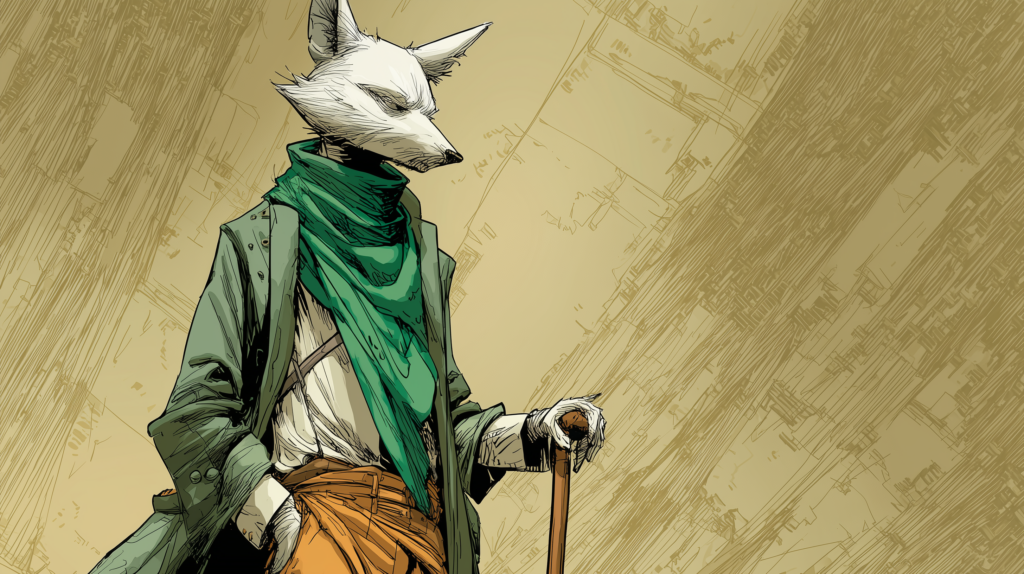
   Vulpecula Noel fidgeted with the fur on his chin, stepping out of his cramped hotel room for the first time in what felt like a century. He looked up at the bright, roaring sunshine overhead, feeling the warmth hit his fur and make the green scarf nestled around his neck feel redundant.

   At long last, a stillness befell the winds, and a settled, lukewarm temperature brushed up against the fur of each civilian as they roamed the streets of Acera. For all the scrutiny they were subjected to, the meteorologists yelled to the skies that this would mark the end of Acera’s frivolous weather patterns, and that prediction proved to be right as rain (or the lack thereof). It was unfortunate that it took them failing five earlier predictions to finally get it right.

   Although his colleagues Apus and Lacerta nor anyone else with a passing knowledge of The Fox Detective would ever accuse him of being particularly outdoorsy, he welcomed the settled, calm weather with open arms. The idea that all the bad weather was, at long last, behind them, was a delusion of grandeur he was willing to get behind. He had withered by the weather and its inconsistencies, with the heavens being unable to decide between attacking the city with rain, heavy winds, or outright snowfall. Who was up there at the reins, he wondered, with it beginning to feel as though God was unaccounted for. Needless to say, he welcomed the sense of normalcy that conventional summer weather brought with it.

   He stepped forward, perusing the streets of North Rites with a newfound pep in his step, poking his walking stick into every nearby puddle, regardless of whether it was in his path or not. It was a discourteous act that didn’t appear to sit well with his lizard friend Lacerta, who sometimes found himself in the cross hairs of each puddle’s splash. Lacerta glared at Vulpecula, an act that made him relent.

   Like a little fox in a candy store, Vulpecula was unable to help himself, because, above all else, what Vulpecula wanted was to return to work on his cases and that could only happen if the weather behaved itself. Vulpecula was largely considered a rookie when it came to his detective work – with the ‘detective’ title in and of itself unofficial and, frankly, unearned (but The Fox Private Investigator simply didn’t have the same ring to it when he was written about in The Rescue Tribune). Regardless, it was rarely difficult for him to find clientele, with his father Hensley Noel being held in high regard in Acera and the greater Maharris. Animals lined up to bring Vulpecula and his friends in to help them solve whatever mystery they’d run into.

   Most of it was vanity for vanity’s sake. Haunted houses that weren’t, in fact, haunted. Creaks and bumps that were actually old houses settling and mysterious specters that were actually old men trying to spook children into staying off their property (they would’ve gotten away with it, too, if it weren’t for the meddling lizard and owl, and their stupid fox). Some of them were even more disappointing – with fans of Hensley Noel either looking at it as an opportunity for a photo op or to have Vulpecula appear on their podcast. Vulpecula didn’t care for these particular cases, both longing to stay out of the public eye as much as he could while also realizing its importance in allowing him to do what he did – a double-edged sword, he supposed.

   What he had to realize, however, is that much like the rest of Acera, criminals didn’t like to leave the house in bad weather either. Which meant no crimes were being committed, which meant no cases to be solved. It was another of those double-edged swords.

   There was something to be said for the thinkers that did their work inside of small cubicles or little, teensy-weensy bedrooms, but Vulpecula wasn’t among those list of thinkers. He was a special type of thinker – carrying a blank chalkboard inside his mind, a crude euphemism for his equally crude photographic memory. The best thing about his blank chalkboard? Unlike a computer at a desk, his chalkboard was completely portable. This was essential, because if there was one thing Vulpecula couldn’t do very well, it was sit still.

   Thankfully for him, he didn’t have to, because the sun was once again ready to shine upon them and, as luck would have it, he had also been welcomed with a new case.

   “Everything feels so much merrier now, doesn’t it? It’s funny but one really does feel happier in the summertime,” Vulpecula said, beholding the great outdoors with a newfound optimism that perplexed his colleagues.

   As a nearby vehicle drove forward, ignoring the white pedestrian’s crossing sign in favor of his own convenience. Vulpecula smiled and waved him off, brushing off the driver’s casual murder attempt and taking it in stride. Oh, how he loved people. Today, at least. Thankfully, for the most part, there was never too much traffic in Acera; it was, after all, the smallest of the five major cities in Maharris, with the North Rites district also being relatively small in scale.

   “The whole town really got wrecked, didn’t it?” Apus said.

   Lacerta nodded. “I heard the hotel clerk talking, apparently some peoples’ houses got destroyed by the floods, cars totaled, yards filled with debris, the whole twenty-seven feet.”

   “I can’t imagine what those people are going through. I heard Rescue was sending out food trucks for people, trying to scavenge up volunteers to clean up the city.”

   Vulpecula stared down at the sidewalk in front of him, noticing all the cracks and crevices, while, at the same time, trying to approximate how much further they still needed to go.

   “It all happened so late at night, too. Imagine waking up and feeling like your whole life was ruined?”

   “Let’s hope the people worst affected will have some good insurance.”

   “For whatever good that’ll do. You see, Apus, that’s the beauty of insurance – is that, when you have it, you actually don’t.”

   Vulpecula could hear the clash in cadence between both Apus and Lacerta’s inflection, one sought to see what was right in the world and the other had a more cynical outlook. Whichever was right or not, Vulpecula’s mind was too preoccupied with his own fairs to pay any mind to what they were talking about. And so, instead, he spoke with urgency: “Where is this McKinley Halls and are we getting anywhere closer to it?”

   Apus peered at his phone, tapping his talons against the screen to zoom in on the map he had pulled up. “It won’t be very much longer now.”

   Lacera chuckled, “On edge a little bit, V? We’ve only been walking for, maybe, a minute or two.”

   “I just want to do … something,” Vulpecula mumbled beneath his breath. “Idle hands and such.”

   Right paw, left paw, right paw, left paw, … Vulpecula took a moment to appreciate the way all their footsteps had become synchronized, then, maybe a conscious decision to quicken his pace to see if they would follow suit. Lacerta wasn’t wrong to think Vulpecula was on edge. There was no denying he was feeling a little bit antsy, wanting so desperately to have something to sink his teeth into.

   “Apus, …,” Vulpecula began, his mouth speaking before his mind knew what it planned to say. “You received this email from Eric Leon, correct?” Vulpecula stopped, and then, continued speaking again, unwilling to wait for an answer. “Eric Leon messaged us last night at eleven o’clock at night and said, as follows, excluding formal salutations:: ‘I am writing this because I know that Vulpecula has proven dignified in his short tenure dealing with unknown mysteries. Colleagues of mine have recommended you repeatedly. While I have only read what the newspapers will share with me, I believe that you will likely find this to be among the strangest cases that you have ever experienced. The sensitivity of this case is all too noteworthy to discuss the contents of in a message over the internet.’ Then, of course, it is followed by the closest remarks, as well as information about McKinley Halls, is that correct?”

   “Amazing,” Apus started, prepared to offer Vulpecula praise for his prowess for recollection.

   Ever since they met, Apus was always able to see the best in The Fox Detective, calling brilliance what others called crazed irregularities and social ineptness. Apus’ friendship was one of the best things to ever arrive gift wrapped at Vulpecula’s doorstep. Unfortunately, Lacerta interrupted him before Apus could pile on the praise. It was for the best. Vulpecula had chosen to intentionally omit the parts of the letter where ‘real‘ law enforcement were too preoccupied with current affairs to give Eric Leon’s predicament the time of day.

   “You can remember, word for word, something that Apus read out loud to us a day ago, but can’t name the mayor of Acera, a place where you have lived for all of your life?” Lacerta shot Vulpecula a look of disbelief, and not in the dumbfounded, impressed way Vulpecula would have liked.

   “To tell you the truth, Lacerta, I can’t even remember what I had for breakfast before we left.”

   It was true, Vulpecula had the memory of an elephant, but, not just any elephant, for that would be bigoted against elephants, the elephant of Vulpecula’s mind had long since been dead. That is, of course, except for anything he etched into his blank chalkboard. The chalkboard was for important things. Things that mattered. Whoever called themselves the mayor of Acera wasn’t among what he would call important.

   “I believe the Rescue Tribune has written a small piece about Eric Leon’s predicament. It’s a pity though, that they haven’t been shipped out yet. The early bird may catch the worm, but they still have to wait for the post office like everybody else, I’m afraid,” Apus said.

   “So, we’re going in blind, as I’d prefer. I would rather not have myself tainted by whatever propaganda The Rescue Tribune has inked and had the audacity to call journalism,” Vulpecula replied, unable and, more accurately, unwilling, to hide his disdain for the organization. His father’s organization.

   “I know you have a bone to pick, but The Rescue Tribune is about the only reason anyone brings us on for these investigations. They did a full-page article about the alien abduction story, everybody we ever help out tells us they found us because they read that story,” Lacerta said.

   “The ‘alien abduction’ story was a bunch of nonsense hysteria from a nonsense district, mistaking kids playing hide and seek for being picked up by an alien aircraft. The Rescue Tribune knew that when they printed it. They have the courtesy of trying to hide it, but the Rescue Tribune is filled with the same type of propaganda as the newspapers printed by the Canes Vinatici were – an us versus them mentality.”

   “I think that might be a little bit of a stretch.”

   Vulpecula looked at Lacerta, but said nothing. The Canes Vinatici was an organization led by dogs throughout Maharris that advocated for the supremacy of itself and the suppression of anybody who dared to stand against it. It was a regime that went on for decades, resulting in innumerable casualties and heart-ache that sent ripples throughout the greater Maharris that was still felt today. It was only after resistances, like the aforementioned Rescue group, that The Canes Vinatici fell from power and a more balanced status quo was restored – one that generally saw puppies paying for the sins of the dogs that came before them.

   “Maybe,” Vulpecula said, once more fidgeting with the fur on his chin. “Then again, maybe not.”

                                                                                              * * *

   They arrived at McKinley Halls some time later, with Apus and Lacerta preoccupying themselves with their company and Vulpecula trying to fan the flames of his own unease. As they arrived, both Apus and Lacerta marveled at the spectacle the building brought with it. It was a large theater, one that was far nicer than anything one could ever expect to see in the North Rites district (they had crossed district lines, welcoming themselves to Acera’s larger, more pristine and busy Mulan district). There was a large sign at the top of the building that said ‘McKinley Halls’ in big, gold lettering with a heavy font and red outline behind a green backdrop. Beside the logo was a statuesque depiction of a human sitting in a director’s chair eating from a classical red-and-white striped bag of popcorn. Although he wasn’t taken by the theaters’ gaudy aesthetic the same way as his colleagues, Vulpecula couldn’t help but find some amusement at the idea of a human of all things sitting in a chair and watching a movie. Vulpecula beheld the large sign in front of the building.

   Welcome to McKinley Halls Theater!

   Home of the Magnets!

   We are Currently Closed.

   Although The Fox Detective knew very little about the theater itself, he had at least heard of the Magnets in passing. They were a traveling troupe of stage performers made up exclusively of Acera-born performers. The troupe took part in many different forms of entertainment, never subscribing themselves to one particular specialty, and, in fact, rebelled against their own comfort. Everything Vulpecula had ever learned about the Magnets had been unintentional, but their outreach couldn’t be denied. They specialized in performances that could best be described as over-the-top, excessive, and bizarre, oftentimes using the spectacle of shock value as a way to go viral online and sell tickets. As the sign would suggest, McKinley Halls Theater was where they preferred to perform most.

   Vulpecula stepped past the sign and began toward the front entrance, hoping not to be thwarted by the rattling of a locked door. To his good fortune, before he could, they were welcomed by a doorman wearing an overcoat and a top hat, an old fashioned ensemble clearly meant to fit the general ‘theme’ of the establishment. The suited penguin quietly let them into the building, informing them that they were expected.

   Soon after, they were introduced to a unique-looking (a generous description) and small stature fellow with a rather eccentric outfit. He wore lavender dance shoes with a sparkling silver embroidered on the laces. He also wore an elegant bright-red coat that had buttons and emblems scattered about, giving him the look of somebody of royalty. His leggings complimented the coat nicely in color, but up close, Vulpecula could see for certain that they were spandex, meant for easy maneuvering. No doubt, Vulpecula was easily able to assume that he was in the presence of an actor (‘actor’ being pronounced with their arm outstretched as ‘ac-tor’). Upon further inspection of his facial features; the puffy and red, blood shot eyes emphasizing his lack of sleep, an unkempt mane, and the fact his boat was messily unbuttoned, Vulpecula realized that this lion went by the name of Eric Leon, the very same who had emailed Apus asking for their services.

   The fact that the doorman introduced him as Eric Leon may have also helped Vulpecula in making this assessment.

   “Welcome,” Eric said in a raspy voice, “I am happy that all three of you could come.”

   Eric Leon’s words, at face value, seemed upbeat and optimistic, however, his voice indicated that he was feeling anything except for happiness.

   “I don’t suppose that I offer you anything before we start, a refreshment of some kind, or, uh, …,” Eric stammered, looking around himself like he would stumble upon some other hidden delicacy to offer them.

   “I would be happy if we could go ahead and jump into what you need help with,” Vulpecula answered coolly, doing his best to both express his urgency and remember his manners, which could sometimes become misplaced when he wasn’t careful.

   “Very well then. I suppose that we should make our way to the stage before we begin, I have no doubts that the scene will be invaluable to you.”

   Eric Leon turned his back to them and began to lead the way – the inside of the building having all the traits of a commonplace theater with some added eccentricities and flourishes. There was a ticket booth as he entered, then, a counter for concessions to his right, meant to sell food and refreshments. To his left, there were framed, back lit posters on the wall for several different plays they had on the docket. Some of them had dates for when the shows were and some of them had little ribbons pinned on them with the names of awards that they had had bestowed on them.

   At last, as they continued following the distraught lion, the rows of posters came to an end, and instead, they were met by doors with numbers on them, each leading to a different theater two watch a different show being performed.

   “So, what exactly is this all about?” Lacerta asked rather abruptly.

   Vulpecula appreciated this, if only because it got things moving and kept him from having to think of a polite way to ask the very same thing. Their eyes went to Eric Leon. Eric didn’t stop to answer, not until after he opened one of the doors, this one had a big, red number ‘3’ written on the top of it. He walked inside and ushered them in to do the same. Vulpecula, Lacerta, and Apus complied, stepping inside and beholding the theater in all its majesty. It wasn’t an enormous venue – when they were walking, Vulpecula made careful note that the first numbered door also had white text beneath it that read ‘Main Stage’. That would seem to imply this was a smaller, less prestigious theater. This theater was capable of sitting a couple hundred theatergoers, at most. Between all the rows of chairs was a walkway leading to the stage which had a large, red curtain draped in front of it.

   “Four days ago, three nights before I sent for your assistance, we were doing a play called The Blood Lane Starlet. Now, I needn’t go in depths about the play’s contents, but I will tell you that the lead part went to a female by the name of Molly Louise, a snow leopard that played the role of the starlet in her rise to fame.” Eric Leon stopped momentarily, as if anticipating that he was about to become emotional. “She was kidnapped before the end of the self act.”

   “So, you’re saying that somebody came in and took her from the dressing room or something? Were there any witnesses?” Lacerta asked.

   Eric Leon started to speak, and then, stopped for a moment, his voice cracking. “No, they kidnapped her during the play!”

   Before, Vulpecula may have only been listening halfheartedly, fearful that he had been hoodwinked with another ‘I saw God in my toast this morning’ type story, but, now, as those words escaped from Leon’s lips, the lion now had his complete and undivided attention.

   “Go on,” Vulpecula said at once, fidgeting with the fur on his chin and staring at Eric Leon intently.

   “While we were doing one of the scenes, she stepped over one of the stages’ trap doors and it was abruptly triggered. There was no scene in the play that called for the trap door, and so, obviously, this should not have happened. The audience was bewildered and confused, and rightfully so, as Molly Louis’ vanished out of sight in the midst of her character’s closing monologue, and are actors were taken aghast by it as well – still, it would be right to say that none of us were in a frenzied panic. The audience thought it was nothing more than part of the act, whereas the performers thought it was a flub by the crew. They lock the trapdoor whenever it is not being used, so these kinds of things don’t happen, but, even still, it didn’t seem like a big deal. Molly would fall safely on a cushion, laugh it off, and we would all carry on with the show as planned, but, then, she didn’t come back.”

   Vulpecula felt his mouth water that the prospect before him, but he didn’t think too much about why that may have been. What it meant, most of all, was that he had a kidnapping to solve! It may as well have been his birthday with the gift Eric Leon had brought him, and although he managed to refrain from breaking out in song, he did find his foot tapping to the beat of his own enthusiasm. Eric Leon seemed unperturbed by this, but Apus poked at Vulpecula with one of his talons to express his dislike for the gesture. Don’t get excited for other peoples’ kidnappings, he thought to himself. It was advice to live by, after all.

   “Did you conduct a search for her?” Apus asked.

   It was a question with an obvious answer and yet, it was simply procedural to ask it. Clearly, Eric Leon wouldn’t have bothered asking for their help if he hadn’t exhausted every other option available to him. Perhaps, as a kindness, Eric Leon didn’t say as much to Apus, and simply offered a nod as an answer. Then, Eric Leon continued: “We contacted the police, but they weren’t able to find anything to go on. They are doing searches and say they are following up on any potential lead they can find. They promise that they will find her, but I just felt like there was more that I could be doing to help than what I was.”

   Eric Leon sauntered over to a row of steps that led up to the stage and disappeared, momentarily, behind the curtains. In the meantime, Vulpecula himself fidgeting with one of the theater chairs, rocking it back and forth for no reason at all whatsoever other than to satiate his own restlessness. Seconds later, Eric Leon returned once more by opening the curtains by yanking on a braided rope.

   “And that’s why I came to you guys for help.”

   “What was your relationship with Molly Louise?” Vulpecula asked.

   “She was my partner.”

   “Your partner?”

   “Yes.”

   Vulpecula may not have been the best at reading facial cues, but, even he was able to read between the lines on what Eric Leon meant by partner and also infer why the puffy-eyed lion appeared to be single-handedly leading the charge for her safe return.

   “And does your partner have a family?”

   “Yes.”

   “And where is that family?”

   “I haven’t heard from them.”

   “And why is that? Surely, a family would have something to say about a missing family member, … or am I wrong about that?”

   Eric Leon hesitated for a moment, but, then, he spoke: “She never really spoke about them very much. I guess, to understand it, you really have to know Molly Louise. It’s kind of why she is such a talented stage performer, she doesn’t carry any baggage with her. This lifestyle fits her like a glove, and I mean, we would always talk about her one day being able to join the Magnets. They say that it’s like a big family with them, and it just seemed like a good way to get away from it all.”

   “This building is home of the Magnets, is it not? Are you a member of the troupe?”

   Eric Leon shook his head. “It isn’t that easy to join their group. Unless you are something special, people will spend years trying to even get an audition for them, much less join. Someday though. Maybe.”

   “Molly Louise has no ties whatsoever with her family?”

   “Correct,” Eric Leon answered simply before elaborating. “She is from Hardan. That is where her folks are. From what I understand, she hasn’t spoken with any of them in several years.”

   With every word Eric Leon let escape, Vulpecula soaked in the man, learning more and more about him every second. His disposition carried a certain eloquence and poise, but it wasn’t enough to hide his roots. He looked and talked like a showman and did everything he could to sell The Fox Detective on that fast, however, in his scruffy, scrambled composure, he let more of himself out than he thought. Eric Leon was an Acera native. Vulpecula could see that well enough, however, it also came with a certain asterisk. He was from the country as they would say, for a reason Vulpecula didn’t actually know why. This by no means meant he was lacking eloquence or a lack of intelligence, but rather to say that he had an accent inherited from what many deemed to be the more ‘lowly’ parts of Acera and was making a conscious effort to hide it. Was this because of an insecurity he had of himself or was it a front he put on because he believed he’d be penalized in some way by the Magnets?

   “You said that everyone was taken by surprise, but what steps were taken after everybody came to realize Molly’s disappearance? The police officers were here before us, did they share any of their discoveries with you?”

   Eric Leon shook his head, “They didn’t do a whole, whole lot, unfortunately. They said that she hadn’t been missing long enough for it to be a proper missing persons’ case, and, you know, with the storm and all the wreckage that’s come with that, they said they’re stretched pretty thin.”

   “Were there any witnesses? Anyone who may have seen anything suspicious?”

   As Vulpecula spoke, he walked up the steps leading to the stage and welcomed himself at eye level with Eric Leon, albeit, not with proper eye contact. Instead, Vulpecula’s eyes looked down toward the trapdoor, head tilted like an old-school slasher villain.

   “A man claimed that, while he was walking out of the theater, he saw a gentleman running outside to his car, as if trying to make a quick getaway. Alongside him was a female, who the man claims was Molly. He said that the man clutched her hand tightly and that she seemed to be afraid.”

   “Can anyone corroborate these claims besides him? Is there any surveillance footage we can pull from?”

   Eric Leon shook his head. “No surveillance footage, before now, we’d never needed it. No one else claims to have seen Molly Louise leave, which makes sense, given that most of them would have been in the theater at the time she would have been taken.” Eric Leon’s voice started to sound a little resentful and agitated but he regained his solemn cadence by the end.

   “Did he see anything beyond that? Surely, whoever the person was she was allegedly walking with would be the key to finding her. What description did he provide for the man?”

   “It was as simple as that,” Eric Leon answered plainly. “As he opened the door, beginning to leave the theater, having seen one of the other shows that McKinley Halls had been running that evening, some older man saw two people leaving the theater. To be as specific as possible, he said that the gentleman leading the way out was of a medium build, perhaps taller than average, wearing a leather trench coat and a black top hat. The man was described as aggressive, pulling her toward the vehicle while she acted both apprehensive and weary.”

   Vulpecula nodded his head. “Who was the older man, what did he look like?”

   Eric Leon looked at Vulpecula in confusion, but, answered, “He was a, uh, rhinoceros, normal size for such an animal, I guess. He wore glasses, I think.”

   “And the man Molly Louise was walking with, you believe this man abducted her against her will?”

   “I see no other explanation other than that. I think, for you to understand better, I should offer a little insight in what it’s like being a theater performer. The performing arts are a tough life, especially someplace that may not have the brightest lights like our district. If it wasn’t for the Magnets sometimes performing here and calling it their home, we would barely have enough business to get by. There is a lot of competition because there are only so many positions that can be filled. It is all about image and it is easy to make enemies without even noticing that you did it.”

   “I will keep that in mind,” Vulpecula said honestly. “Thank you for your time, Eric Leon, but, for now, I must ask that you bid yourself adieu from us. I am sorry to say it, but, unlike you, I am up to the task much more when I don’t have an audience. I hope that I will be able to bring you new information very soon to your partner’s whereabouts.”

   Eric Leon seemed disheartened by the request, but, to his credit, he obliged and left the trio alone to revel in their thoughts. Vulpecula didn’t say anything to either Apus or Lacerta, and they said nothing to him. Apus and Lacerta stood quietly, leaving Vulpecula to attempt to unravel the situation before them.

   Eric Leon meant well, Vulpecula believed. Still, the idea that Molly Louise had been abducted straight from the stage was an unlikely event. Why would any criminal commit such a crime? There was simply too many dramatics and too much risk involved. The Fox Detective’s mind immediately considered the idea of extortion or blackmail, but that wouldn’t have explained why the kidnapper would commit themselves to such theatrics. Surely, it would have been easier to find Molly Louise sometime after the show and abduct her when there were less witnesses to call upon. For whatever reason, the criminal clearly wanted there to be showmanship and for a powerful message to be sent.

   “Do you think it’s possible that Molly Louise was kidnapped?” Apus asked.

   “It is possible, certainly, but, whether or not it’s plausible remains to be seen.”

   “I thought I saw you biting your tongue while Eric was talking,” Apus said sharply, a small smirk somehow visible from his beak.

   “He referred to the man that allegedly saw the kidnapper and Molly Louise leaving into the car as an older rhinoceros, an animal species known for their bad eyesight, who wore glasses, no less. Furthermore, consider how dark it would have been and how erratic the weather has been lately. The witness would have had their vision considerably obstructed by the pouring rain, coupled with the high likelihood that they already don’t have the best vision.” Vulpecula once more didn’t make eye contact with Apus or Lacerta; he continued to find himself transfixed on the trap door.

   There was another thought bouncing around in Vulpecula’s head as well, one pertaining to the rhinoceros’ testimony. As defeated as it sounded, he wished that he had not let Eric Leon leave like he had, now finding himself with a new question he otherwise had no way of getting the answer to. Vulpecula descended the stairs, half his mind still drawn by the trapdoor itself, but the other half of him that took the reins knew he needed more information to, ahem, set the stage (a joke he kept for himself as an audience of one). Leaving Apus and Lacerta to further investigate the theater – which included Lacerta snapping photographs of every possible object, whether it was the stage itself or the fancy, sparkly chandelier over their head (it wasn’t about evidence or clues, per se, but, rather, it was about having photographs to sell to The Rescue Tribune or for their website – a gaudy, but, alas, important part of why they were able to do the things they did).

   The Fox Detective opened the large door, leading to concessions, his eyes surveying the area for the fancily-dressed lion. As he did, however, he found himself unable to spot him. He did, however, see the doorman.

   “Pardon,” Vulpecula said, getting the penguin’s attention. “I don’t suppose you can tell me where to find Eric Leon? I had a couple of small questions to ask him before I returned to the investigation.”

   The doorman shot him a peculiar look, “The investigation? That’s why you’re here? This is about Molly Louise?”

   “Who else?” Vulpecula asked.

   The penguin shrugged. “When Eric Leon told me his friend Vulpecula Noel was coming to look around the theater, I figured you were here because you were a theater buff or something. I didn’t realize you were going to conduct an ‘investigation’,” The doorman smirked, with the emphasis on Vulpecula’s last name and not his first making it clear he was familiar with his father’s work and not his.

   Vulpecula bit his bottom lip and decided to pick his battles, everyone started somewhere, he supposed. “Can you tell me where I can find Eric Leon?”

   Once more, the penguin shrugged: “Probably doing his job.”

   “What, … you mean, rehearsing, or … ?”

   The penguin chuckled, “I mean, he’s cleaning, I think he’s sprucing up the main theater.”

   “Eric Leon’s a custodian?”

   “A custodian,” The penguin laughed some more. “Trying to look important, are we? Guy’s not even a janitor. Janitors’ get paid. He’s like an intern. He cleans up and helps out with things, and, in return, they let him put on his little costumes and shadow the actors. Basically, in McKinley Halls, if you aren’t a Magnet, you aren’t nothing, and if you’re nothing, that means you’re probably a local stage actor for the Mulan district, and Eric Leon is somewhere below that.”

   This time, Vulpecula wasn’t able to withhold his disappointment, letting out an audible sigh. It was remarkable how easily perception of something could change and a whole investigation could be unwound. This wasn’t Eric Leon giving Vulpecula the reins to lead an investigation. Eric Leon didn’t have the reins to pass off in the first place. This was an underpaid (in-fact, unpaid) employee asking a wannabe sleuth on the internet for his two cents before the theater opened to the public. Eric Leon didn’t maybe, exactly, lie, but he absolutely misled him. What else had he lied about, a voice in the back of Vulpecula’s mind whispered.

   “Okay then, maybe you can help me. Eric Leon said that law enforcement had a witness that claims to have seen Molly Louise leaving the building after another play had just gotten let out. What time did the other play and where would that overlap with the time of The Blood Lane Starlet’s third act when Molly Louise went missing?” Vulpecula asked.

   “I don’t know if I should reveal information involving an official investigation.”

   “Trying to look important, are you? It’s simple math – you either tell me or I assume you can’t, and I find out myself.”

   The doorman smiled again, but this was a different kind of smile. This was the kind of smile that came from someone with a freshly bruised ego. Vulpecula could empathize.

                                                                                                       2.

   The Fox Detective stood on the stage once more. Vulpecula closed his eyes and looked through the innermost confines of his mind, his blank chalkboard, as he called it in his mind. The chalkboard stared back at him, wrapped in vines, sprouted from the seeds of doubt planted in him by every naysayer. Beyond that, it was filled with all the notes and information he had taken in regarding the case. On the surface, he remained quiet. As a child, his Uncle Rockwell called this Vupecula ‘putting on his space helmet’, a euphemism for what he perceived as simple daydreaming. It was something more than that, however. At this moment, he could see everything. Sooner or later, the blank chalkboard would be erased, making way to keep new information, but, for now, he had it all.

   In his head, he saw Eric Leon. All the movements that he made; every mannerism he had done during their conversation was accessible to him. What was the endgame for asking Vulpecula for his aid?

   Out of his head, Vulpecula looked down at the trapdoor. The door was simple, unlike some other trapdoors that may have been lever activated, this one had a latch to unlock the trapdoor under the stage. Surely, more complicated, expensive theatrics were reserved for the main theater. What did this mean? The most obvious was that this had to be carefully deliberated. All it took was applying enough pressure and the trapdoor gave way, sending whoever triggered it down, beneath the stage. Anyone could have triggered it at any moment. The kidnapper would have had to have eyes on the stage to know when Molly Louise was in position or, at the very least, have the timing down to know when the rest of the performer’s had no chance of sabotaging their plan.

   “Did you hear me,” Lacerta called out, snapping his fingers in front of Vulpecula’s eyes, trying to get his attention. “Did you hear what I said?” He asked again, uncertain if he was getting through.

   “Not a word,” Vulpecula answered honestly.

   Lacerta sighed. “I said … do you believe that we should just throw out the witness’ account since there is a chance the rhinoceros couldn’t have Molly Louise and her abductor?”

   “No,” Vulpecula said, shaking his head. “It’s a variable, for certain, but I think the witness testimony is a very important part whether they saw Molly Louise or not.”

   Vulpecula looked around at the stage, appreciating the scenery. There were props strewn about, background decorations such as trees that enshrouded themselves around a makeshift fire escape – the trees serving the purpose of hiding the wheels used to lug the fire escape from place to place. There were sandbags and pulleys and other things that Vulpecula understood the general purpose of, but appeared foreign to him in the context of how they worked to create the overall presentation. He eventually brought himself to Stage Right (one of the few insider terms Vulpecula knew of – basically, it meant, ahem, the right of the stage) and looked at a white prop wall with red paw prints speared across it, meant to resemble blood.

   As he went down the stairs leading to the backstage, he opened a door and was then able to behold the area dedicated to makeup. It looked the way he had always imagined it in his head, with a row of five empty stools, each in front of small tables with mirrors outlined by large light bulbs. On the side closest, facing the theater, there were racks with clothing, out-of-place ladders (a clear violation that Vulpecula would leave ‘The Fox Safety Coordinator’ to cite), and pieces of plywood. The opposite side had doors clearly designated as fitting rooms. Finally, however, Vulpecula found the room he was looking for – a small, red push and pull plate door with a sign at the top that spelled out its purpose: “Storage”.

   He opened the door and, true to its word, there were plenty of boxes and props stored away, collecting dust. It wasn’t the most aesthetically appeasing room. There’d be no ‘behind the scene tour’ videos showing off the loose nails that poked through the ceiling and ‘do it yourself’ support beams that were scattered around the area. In the greater Maharris, Urgway was considered the poorest of the poor, the worst place to live altogether, riddled with crime and bad living conditions. At this moment, Vulpecula couldn’t help but wonder what horrors Urgway could truly have if this was considered one of the nicer districts of Acera.

   His eyes searched the room, not looking for anything in particular, but also looking for exactly what he needed. He walked over to the cushion lying in the middle of the room. In a choice that felt, almost poetic, the cushion was a scarlet red color. Above him, he could see the bottom of the trapdoor as well as the latch that looked it in place.

   What would she have imagined at this moment? The Fox Detective did his best to place her in his shoes. He imagined himself on the stage. Stepping around, an uproarious audience watching on. The doorman may have been a lot of things, and a lot of those things may not have been good, but one thing he had also been was helpful and informative. This was Molly Louis’ time to shine! This was the first time she was front and center as the lead in a play at McKinley Hall and The Blood Lane Starlet was exactly the kind of play for an actor to prove themselves to her audience. To her audience? To the Magnets, Vulpecula thought again. If you aren’t part of the Magnets, you’re nothing. This was her chance to get their attention. Of course, even then, she’d have trouble being accepted, Vulpecula thought. Why did he think that? Eric Leon had claimed she was a native of Hardan. That was directly against the rules for entry into the Magnets – an Acera-only troupe.

   Unless she could do something to force the issue, he supposed. Like faking her kidnapping? Or maybe not. Vulpecula tried to imagine it as though she hadn’t. That she felt astonishment as the trapdoor fell beneath her feet. This wasn’t in the script, … but then, what? She walked out from the dressing room and no one saw anything at all? No one saw The Blood Lane Starlet herself fleeing out of the theater? No one except for a single rhinoceros? Why did she let herself be kidnapped by the older gentleman? She wasn’t incapacitated. She left on her own accord. Was there a gun to her back? Was this extortion or blackmail?

   Vulpecula didn’t have enough information to have an answer yet. He imagined what Molly would have seen the moment the floor fell from beneath her. Either she was expectant of it or disoriented by it, that all depended on if this was a grand illusion or an actual kidnapping. Where would she have gone next? At first, The Fox Detective looked at the door he had come in from. That couldn’t have been it. Surely, the moment Molly Louise fell, members of the production crew would be scurrying to retrieve her. The idea that none of them saw her meant that door was not an option. His eyes surveyed the area in search of an alternative way out, and, he found it. The small door stared back at him with a proposed answer to the case spelled out for him in blunt lettering: Maintenance.

                                                                                                    3.

   “So, you’re saying you believe that Eric Leon was in cahoots with Molly Louise and helped stage her kidnapping?” Apus asked.

   Lacerta chuckled, clearly finding some amusement in a ‘staged kidnapping’ happening on a stage.

   “I am,” Vulpecula said, stopping for a moment, “Not saying that?” The Fox Detective answered, not originally planning to end his sentence with a question mark.

   “That doesn’t sound very confident.”

   “Why would Eric Leon ask for our help if he was the one who instigated the crime in the first place?” Lacerta asked.

   “Because he underestimated us, he didn’t think we’d find anything because the police didn’t but also didn’t want to look like he was hiding anything either,” Apus said.

   Vulpecula fidgeted with the fur on his chin. “Everything we do gets reported to The Rescue Tribune. Every case we solve gets put on Lacerta’s website and stirs up conversation. If this was all a giant ploy to bring eyes to Molly Louise and get her accepted into the Magnets, then it makes sense they’d call on us to add a little more publicity to the affair.”

   “So, you are saying Eric Leon asked for our help because he thought we’d bring more eyes to the case?” Apus asked.

   “I,” Vulpecula hesitated again, “Am saying that. But I am not ready to say it was for the same reason we’re thinking.”

   “What?” Lacerta asked, clearly confused.

   “I don’t think Eric Leon’s worry is fake,” The Fox confessed. “I don’t think he could fake that.”

   “He’s an actor.”

   “Perhaps, but not a good one. The penguin upfront claimed there is a hierarchy and that Eric Leon was, more or less, at the bottom of the heap.”

   “The only other possible exit from the bottom of the stage was the maintenance room, it would have offered a straight shot from backstage to the main lobby. Eric Leon could have easily been waiting for Molly Louise and then helped her make her clean getaway.” Lacerta argued.

   “The witness claims to have seen her walking out from the lobby with an older gentleman,” Vulpecula said plainly, awaiting the holes to be poked in the statement.

   “And you said it yourself that a rhinoceros contending with bad weather and bad eyesight is a tough sell.”

   “Perhaps so, but Eric Leon also has an alibi. I spoke to the doorman about the rhinoceros. When the trapdoor fell through, leading to Molly Louis’ disappearance, that would have been about half an hour before the end of the Blood Lane Starlet and about fifteen minutes before the end of the play said rhinoceros had attended. That tells us two things. One is that the rhinoceros would have seen Molly Louise walking out in an otherwise empty lobby, meaning that our witness and his weak bladder would have had a clear shot of Molly Louise leaving the building. The second is that Eric Leon was present and accounted for to help clean the theater after the next play was let out.”

   “So, you think Eric Leon wasn’t involved? That it was Molly Louise and, what, a member of the Magnets?”

   “I believe that Eric Leon was involved,” Vulpecula said, then, added: “But not directly. When I was a young boy, I remember I would sometimes be babysat by Vivian Herms, believe it or not.”

   “Sounds awful,” Lacerta fired back.

   A small smile broke on Vulpecula’s face. Vivian Herms was his father’s right-hand, a stoic, serious-natured woman who now called the shots as the leader of the Rescue organization. “As you can probably guess, there weren’t exactly a lot of toys to play with or things to occupy a small child’s mind in her office. There was, however, a small nest-egg doll I remember sat at the front of her desk. It was a simple wooden toy shaped like a bowling pin and when you pulled it apart, a smaller version of the same toy was tucked inside. You open that one, and there was another, and so on and so forth.”

   “I’m familiar.”

   “At McKinley Halls, you are either a Magnet or you are nothing, and if you aren’t nothing, by the door man’s assessment, you must be Eric Leon.”

   “Harsh.”

   “And, untrue. Eric Leon was a contingency. Molly Louise knew she was going to disappear before her audiences’ eyes, but she couldn’t account for the storm to hit and everyone’s attention to be pulled elsewhere. She thought it would be breaking news and the media would run with it, but it simply wasn’t. In simpler times, the police would have overlooked their forty-eight hour rule and went straight to work, but they were simply too stretched thin to take on a case with nothing to go on. Her last ditch effort was Eric Leon. In Eric Leon’s email, he claimed that colleagues had recommended us to him repeatedly. Unfortunately, by the door man’s account, Eric Leon had only one colleague and that colleague would have had everything to gain from him knowing the one detective in Acera that hadn’t been caught up in the storm. When he saw no one was helping her, he followed his heart.” The Fox Detective explained.

   “Then, what do we do now?” Lacerta asked.

   “Nothing,” Vulpecula said honestly. “This is nothing more than a performance. Another case that went nowhere. When the police officers’ hands are freed, they’ll investigate further. When they do, they’ll find an answer, but, by then, all of the momentum and drama will have spilled out. Molly Louise won’t get what she wants and may very well miss out on her one chance to join the troupe.”

                                                                                                  ***

   It wasn’t long until what Vulpecula said would happen, in fact, happened. He had kept his tabs on the investigation and had advised Eric Leon to inform him of any new developments. The last thing he wanted was to have gotten it wrong, so it was a relief to see that he hadn’t. By the time the forty-eights hours expired, allowing the Mulan districts’ police department to officially call it a missing persons’ case, all of the air had been let out from the fiasco. Without even as much as a two-bit detectives’ two cents on the case, that added up to a one-two punch on any hopes Molly Louis had at becoming a viral sensation. Then, in a week’s time, since Molly Louis clearly wasn’t about to become the overnight starlet the Magnets’ expected, but still needed money to live, she returned, pretending like nothing had happened.

   As one could imagine, McKinley Halls wasn’t too thrilled about their main-actress disappearing in the middle of a stage production, and she was demoted – in an ironic twist, she became the smallest doll in the nest-egg.

   Vulpecula looked at the sky somberly.

   “So, that’s it then?” A voice called out to Vulpecula, breaking him out of his little trance.

   Eric Leon looked back at him, dressed in his usual theatrical ensemble. Vulpecula stared at the ‘Welcome to McKinley Halls’ sign. He wasn’t certain why he had returned, but the moment he saw Eric Leon, he felt like he had a good idea.

   Vulpecula ignored the question, not really knowing the answer: “That’s an interesting suit, Eric. It looks a little like tiger fur. It’s strange to see on a lion. Strange, in a good way. Looks nice.”

   “It’s faux fur,” Eric said a small twinge of enthusiasm escaping his otherwise melancholic disposition.

   “I would hope so.”

   “I had it specially imported from a place called Paw Prints, they specialize in the finest faux fur.”

   “Very cool.”

   After a small pause, Eric Leon finally asked the question their awkward small talk was leading to, the only reason Vulpecula would participate in small talk.

   “Why didn’t she tell me, Vulpecula? What did I do wrong?”

   “You didn’t do anything, Eric. Your only crime was being genuine and real.”

   Eric Leon chuckled. “Being genuine doesn’t get you very far as an actor.”

   “Maybe not, but it means everything to me.” Vulpecula said, letting a small smile show through. Below the sign, he observed a small listing of upcoming shows, finding Eric Leon’s name among the cast. V pointed his walking stick at the listing and looked back at him. “Break a leg, Eric.”

   “Thanks.”

   Vulpecula turned to make his leave, and, as he did, Eric spoke once more.

   “You think it’s going to rain?” Eric Leon asked.

   Vulpecula looked back at him, then, up toward the sky, “I think a storm’s coming.”

   “Better buy an umbrella,” Eric said in jest.

   “I think I’ll be okay.”

   I’ve got my space helmet.